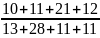
Q1. A bag contains equal number of 25 paise, 50 paise and one rupee coins respectively. If the total value is Rs 105, how many types of each type are present?
(a) 75 coins
(b) 60 coins
(c) 30 coins
(d) 25 coins
Ans. b
Sol. Bag consists of 25 paise, 50 paise, and 1 rupee coins (100 coins)
So the ratio becomes 25 : 50 : 100 = 1 : 2 : 4
Total value of 25 paise coins =  105 = 15
Total value of 50 paise coins =  105 = 30
Total value of 100 paise coins =  105 = 60
Therefore,
Number of 25 paise coins = 15 × 4 = 60
Number of 50 paise coins = 30 × 2 = 60
Number of 1 rupee coins = 60 × 1 = 60
⇒ There are 60 number of coins of each type
Alternate Method
Let the number of coins be x one rupee is equal to 100 paisa, 105 rupee is equal to 10500
⇒ 100x + 50x + 25x = 10500
⇒ 175x = 10500
⇒ x = 60
∴ The number of coins of each value is 60.
Q2. A purse contains 392 coins consisting of one rupees, 50 paise and 25 paise coins. If their values are in the ratio of 11 : 9 : 5 then find the number of 50 paise coins?
(a) 180
(b) 150
(c) 144
(d) 99
Ans. c
Sol. Let x, y, and z be the number of coins in each category of Rs. 1, Rs. 0.5, and Rs. 0.25 respectively.
Given,
x + y + z = 392 —— (i)
x : 0.5y : 0.25z = 11 : 9 : 5
⇒ x = 11k , 0.5y = 9k , 0.25z = 5k
⇒ x = 11k , y = 18k , 0.25z = 20k
Equation (i) can now be written as
11k + 18k + 20k = 392
49k = 392
⇒ k = 8
Therefore the number of 50 paise coins, y = 18×8 = 144
Q3. A certain sum of money is distributed among Ravi, Rahul, and Raj in ratio 8 : 5 : 7 in such a way that share of Ravi was Rs. 1000 less than that the sum of share of Rahul and Raj. Find the difference between the shares of Ravi and Raj?
(a) 450
(b) 350
(c) 250
(d) 150
Ans. c
Sol. The ratio in the distributed amount of Ravi, Rahul and Raj = 8 : 5 : 7
Let the Ratio of money distributed among Ravi, Rahul and Raj = 8x : 5x : 7x
Ratio of Rahul and Raj = 5x + 7x = 12x
Difference between the ratio of Ravi and Rahul = 12x – 8x = 4x
According to question,
4x = 1000
⇒ x = 250
Then share of Ravi = 8x = 250 × 8 = 2000
Share of Raj = 7x = 250 × 7 = 1750
Difference between shares of Ravi and Raj = 2000 – 1750
∴ Difference between shares of Ravi and Raj = 250
Q4. If 10% of x is equal to 20% of y then x:y is
(a) 1 : 2
(b) 2 : 1
(c) 1 : 3
(d) 3 : 1
Ans. b
Sol. The value of 10% of x =  ×x
×x
The value of 20% of y = ×y.
×y.
Equate these equations to find the ratio
 ×x =
×x =  ×y
×y
x = 2y
 = 2
= 2
⇒ x : y = 2 : 1
Therefore, the ratio of x: y is 2 : 1.
Q5. The compounded ratio of (2:3), (6:11) and (11:2) is :
(a) 1 : 2
(b) 2 : 1
(c) 3 : 1
(d) 1 : 3
Ans. b
Sol. Compounded Ratio :: When we compound two or more ratio’s with each other through product or multiplication, the result is simply a compound ratio.
Thus, the product of two or more ratios; i.e, ab:cd is a ratio compounded of the simple ratios a:c and b:d.
Required compounded ratio =  =
= 
⇒ Ratio = 2 : 1
Q6. In a library, the ratio of the number of story books to that of non-story books was 4 : 3, and total number of story books was 1248. When some more story books were bought, the ratio became 5 : 3. Find the number of story books bought.
(a) 312
(b) 321
(c) 936
(d) 1560
Ans. a
Sol.  =
= 
Non story books =  × Story books
=  × 1248 = 936
Let M story books be added. So number of story books = 1248 + M
Now,
 =
= 
 =
= 
1248 + M = 1560
M = 312
Q7. Rs. 8400 is divided among A, B, C and D in such a way that the shares of A and B, B and C, and C and D are in the ratios of 2:3, 4:5 and 6:7 respectively. The share of A is
(a) Rs. 1280
(b) Rs. 1320
(c) Rs. 8400
(d) Rs. 8210
Ans. a
Sol. The ratio of the present age of father to that of son is 7:2. After 10 years their ages will be in the ratio of 9:4. The present ages of the father is
(a) 30 years
(b) 40 years
(c) 35 years
(d) 25 years
Ans. c
Sol. The ratio of the present age of the father to that of his son = F : S = 7 : 2.
Let the present age of the father (F) = 7x the present age of son (S) = 2x from the given data
⇒  =
= 
⇒ 28x + 40 = 18x + 90
⇒ 28x – 18x = 90 – 40
⇒ 10x = 50
⇒ x = 5
So, the present age of the father (F) = 7x = 7 × 5 = 35 years.
Alternate Method
Ratio of father age to sons age = 7 : 2
Father age should be divisible by 7
Only 35 is divisible by 7 in the given options
So, the fathers age is 35 years
One more method
10 years represent a shift of 9 — 7 = 4 — 2 = 2 in the ratio, so 10 years should also be represented by 2 in the ratio itself.
Answer
= 10 ×  = 35 years old
Q9. The monthly incomes of A and B are in the ratio 4 ∶ 3. Each of them saves Rs. 600. If the ratio of their expenditures is 3 ∶ 2, then the monthly income of B is –
(a) 1800
(b) 2000
(c) 2400
(d) 2800
Ans. a
Sol. Ratio of monthly incomes of A and B = 4 : 3
Ratio of expenditures of A and B = 3 : 2
Let the incomes of A and B be ‘4x’ and ‘3x’.
So,
 =
= 
⇒ 2 × (4x – 600) = 3 × (3x – 600)
⇒ 8x – 1200 = 9x – 1800
⇒ x = 600
The monthly income of B = 3 × 600 = Rs. 1,800
Alternate method
Let income be denoted by X and expenses by Y
Then monthly incomes of A and B are in the ratio of 4X : 3X and their expenses bear the ratio 3Y : 2Y
A’s savings=4X – 3Y=Rs 600—————-(i)
B’s savings=3X – 2Y=Rs 600—————- (ii)
Solving eq (i) and (ii), we get
X=600
The monthly income of B=3 × 600=Rs 1800
One more method
Monthly income of A & B are 4x & 3x
Monthly expenditure of A & B are 3y & 2y
as per given data
4x – 3y=3x – 2y=600
4x – 3y=3x – 2y
x = y
then
4x – 3y=600
4x – 3x=600
X=600 and y=600
Monthly income of B = 3x =3×600 = 1800
Q10. Ajay and Raj together have Rs. 1050. On taking Rs. 150 from Ajay, Ajay will have the same amount as what Raj had earlier. Find the ratio of amounts with Ajay and Raj initially.
(a) 3 : 4
(b) 7 : 1
(c) 1 : 3
(d) 4 : 3
Ans. d
Sol. Let the initial amount with Ajay be ‘A’ and that of Raj be ‘B’. Then
A + B = 1050 —— (i)
Also, Rs. 150 is taken from Ajay. So,
A – 150 = B
⇒ A – B = 150 ——- (ii)
Adding eq (i) and (ii), we get
2A = 1200
⇒ A = 600
Which is initial money with Ajay
∴ B = 600 – 150 = 450
Ratio of A : B = 600 : 450 = 4 : 3
Q11. If a : b = 2 : 3 and b : c = 5 : 7, then find a : b : c.
(a) 12 : 15 : 9
(b) 10 : 15 : 21
(c) 14 : 12 : 21
(d) 2 : 15 : 7
Ans. b
Sol. Let A get 2k (k=proportionality constant) B get 3k.
When B get 5k then C get 7k.
Multiply above by 5 and below by 3.
A : B : C will be 10k : 15k : 21k.
A : B : C=10 : 15 : 21
Calculation
If A : B : C = 3 : 4 : 7, then what is the ratio of  : :  : :  ? ?
(a) Ans. a 63 : 48 : 196 (b) 76 : 49 : 190 (c) 56 : 40 : 186 (d) 46 : 38 : 160 Sol. Let A = 3x, B = 4x and C = 7x Then,
LCM of 3 , 4 , 7 = 84 ⇒(i) ⇒(ii) ⇒(i) ratio of (A / B) : (B / C) : (C / A) = 63 : 48 : 196 Q12.
If Suresh distributes his pens in the ratio of (a) 153 (b) 150 (c) 140 (d) 127 Ans. a Sol. Distribution ratio of LCM of 2, 4, 5, 7 = 140 Now, find the number of number of pens each friend got ⇒(A) ⇒(B) ⇒(C) ⇒(D) Total pens = 70 + 35 +28+ 20 = 153 Q13.
If Rs 1050 is divided into three parts, proportional to (a) 500 (b) 300 (c) 200 (d) 100 Ans. c Sol. LCM of 3, 4 , 6 = 12, Therefore, multiply the numerator and denominator of
Let ‘m’ be one the parts of of 1050. Therefore,
⇒ m = 600 So, first part = Q14. In a mixture of 13 litres, the ratio of milk and water is 3 : 2. If 3 litres of this mixture is replaced by 3 litres of milk, then what will be the ratio of milk and water in the newly formed mixture? (a) 10 : 3 (b) 8 : 5 (c) 9 : 4 (d) 1 : 1 Ans. c Sol. Total quantity of mixture = 13 litres and 3 litres of mixture is removed from the container Now, you are left with only 10 litres of mixture in 3 ∶ 2 ratio. ⇒ Milk in 10 litres mix = 10 × ⇒ Water in 10 litres mix = 10 × We add 3 litres milk to this. ⇒ Milk in new mix is = 6 litres + 3 litres = 9 litres ⇒ Water = 4 litres ∴ Ratio of milk ∶ water = 9 ∶ 4 Alternate Method 13 litres – 3 litres= 10 litres. 3:2 ratio means in 5 parts of liquid, 3 is milk, 2 is water. So in 10 litres, 6 will be milk, 4 water. Now add. 3 litres of milk. 9 litres of milk, 4 litres water are in the ratio of 9 : 4. Q15. The annual income of Puja, Hema and Jaya taken together is Rs. 46,000. Puja spends 70 % of income, Hema spends 80 % of her income and Jaya spends 92 % of her income. If their annual savings are 15 : 11 : 10, find the annual saving of Puja? (a) 3, 000 (b) 2, 000 (c) 1, 500 (d) 5, 000 Ans. a Sol. Total monthly income of Puja, Hema and Jaya is Rs. 46000. Let Puja be denoted as ‘A’, Hema be ‘B’ and Jaya be ‘C’ respectively. A spends 70% of income, B spends 80% of income and C spends 92% of income. We know that, Savings percentage = 100 – Percentage amount spent A + B + C = 46000 Let savings of A, B and C be Rs. 15a, Rs. 11a and Rs. 10a respectively. Savings of A is (100 – 70) = 30% Savings of B is (100 – 80) = 20% Savings of C is (100 – 92) = 8% Accordingly, (15a × ⇒ 230a = 46000 ⇒ a = 200 Monthly savings of A = 15a = Rs. 3000 ∴ Monthly savings of A is Rs. 3000 Q16. A man, his wife and daughter worked in a garden. The man worked for 3 days, his wife for 2 days and daughter for 4 days. The ratio of daily wages for man to women is 5 : 4 and the ratio for man to daughter is 5 : 3. If their total earnings is mounted to Rs. 105, then find the daily wage of the daughter. (a) Rs. 15 (b) Rs. 12 (c) Rs. 10 (d) Rs. 9 Ans. d Sol. Assume that the daily wages of man, women and daughter are Rs. 5X, 4x, and 3x respectively. Multiply (no. of days) with (assumed daily wage) of each person to calculate the value of x. [3×(5x)] + [2×(4x)] + [4×(3x)] =105 15x + 8x + 12x = 105 x=3 Hence the daughters daily wage = 3x = 9 Q17. Amit, Raju and Ram agree to pay their total electricity bill in the proportion 3 : 4 : 5. Amit pays first day’s bill of Rs. 50, Raju pays second day’s bill of Rs. 55 and Ram pays third day’s bill of Rs. 75. How much amount should Amit pay to settle the accounts? (a) Rs. 15.25 (b) Rs. 17 (c) Rs. 12 (d) Rs. 5 Ans. d Sol. Total bill paid by Amit, Raju and Ram = 50 + 55 + 75 = 180 Let the amount paid by Amit. Raju and Ram be 3x, 4x and 5x Therefore, 3x+4x+5x = 180 ⇒ x = 15 Therefore amount paid by Amit = 45 Raju = 60 Ram = 75 But actually as per the question, Amit pays Rs. 50, Raju pays Rs. 55 and Ram pays Rs. 80. Hence Amit paid Rs. 5 less than the amount to be paid. Hence he needs to Rs. 5 to Raju to settle tha amount Q18. Salaries of Ram and Shyam are in the ratio of 4 : 5. If the salary of each is increased by Rs. 5000, then the new ratio becomes 50 : 60. What is Shyam’s present salary? (a) Rs. 20,000 (b) Rs. 25,000 (c) Rs. 30,000 (d) Rs. 35,000 Ans. c Sol. Assuming original salaries of Ram and shyam as 4x and 5x Therefore,
60(4x+5000) = 50(5x+5000) 10x = 50000 x = 5000 Shyams present salary = 5x+5000 = 25000+5000 = 30000 Q19.
(a)
(b)
(c)
(d)
Ans. a Sol. ∴ k = Join & Follow Us for Daily Updates!
|