
 is divided by 34
(a) 37
(b) 40
(c) 32
(d) 34
Ans. c
Sol. R=
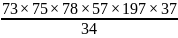 R=
R=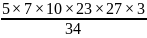 (we have taken individual remainders, which means if 73 is divided by 34 individually, it gives a remainder 5, and 75 divided by 34 gives remainder 7 and so on) R=
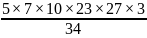 R=
R=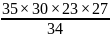 R=
R=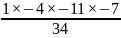 (we have taken here negative as well as positive remainders at the same time. When 30 divided by 34 it will give either remainder 30 or negative remainder 4. We can use any one of the negative or positive remainder at any time) R=
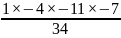 R=
R= R=
R= R=
R= ⇒R=32
⇒R=32 In simple steps R =
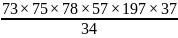 R =
R =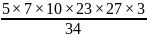 R=
R=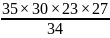 R=
R=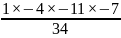 R=
R= R=
R= R=
R= ⇒Remainder=32
Q2. Let N=
⇒Remainder=32
Q2. Let N= . What is the remainder when N is divided by 12
(a) 3
(b) 6
(c) 9
(d) 7
Ans. a
Sol. Remainder (R) =
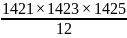 R =
R =  (taking individual remainders for 1421, 1423 and 1425, which gives remainders 5, 7 and 9 respectively)R =
  R =
R =  ⇒R=3
⇒R=3Q3.
If one-third of one-fourth of a number is 15, then three-tenth of that number is:
A two-digit number is such that the product of the digits is 8. When 18 is added to the number, then the digits are reversed. The number is:
x – y = 4.
Q7. What is the least number of soldiers that can be drawn up in troops of 12, 15, 18 and 20 soldiers and also in form of a solid square?
(a) 56
(b) 51
(c) 59
(d) 54
Ans. d
Sol. Let the number be x The  of
of  of x = 15 ⇒ x =
  = 180 So, three-tenth of 180 =
  ⇒ R = 54
Q4. Three times the first of three consecutive odd integers is 3 more than twice the third. The third integer is:
⇒ R = 54
Q4. Three times the first of three consecutive odd integers is 3 more than twice the third. The third integer is:
(a) 21
(b) 15
(c) 10
(d) 18
Ans. b
Sol. Let the three integers be x, x + 2 and x + 4.Then, 3x = 2(x + 4) + 3⇒ x = 11.∴Third integer = x + 4 = 15.
Q5.
(a) 9
(b) 7
(c) 2
(d) 6
Ans. c
Sol. Let the ten’s and unit digit be x and  respectively Then
 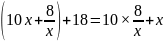 ⇒
⇒  ⇒
⇒  ⇒
⇒  ⇒
⇒  ⇒ x =2
Q6. The difference between a two-digit number and the number obtained by interchanging the positions of its digits is 36. What is the difference between the two digits of that number?
⇒ x =2
Q6. The difference between a two-digit number and the number obtained by interchanging the positions of its digits is 36. What is the difference between the two digits of that number?
(a) 7
(b) 9
(c) 4
(d) Cannot be determined
Ans. c
Sol. Let the ten’s digit be x and the unit’s digit be y.Then, (10x + y) – (10y + x) = 369(x – y) = 36
(a) 2100
(b) 400
(c) 1600
(d) 900
Ans. d
Sol. In this type of question, We need to find out the LCM of the given numbers. LCM of 12, 15, 18 and 20; 12=2×2×3; 15=3×5;