
Q1. Two numbers such that the sum of twice the first number and thrice the second number is 100 and the sum of thrice the first number and twice the second number is 120. Which is larger number ?
(a) 32
(b) 54
(c) 41
(d) None of these
Ans. a
Sol. Let the two numbers be x and y. Then as per the question
2x + 3y = 100 ——-(i)
3x + 2y = 120 ——-(ii)
By Solving equation (i) and (ii). We get
x = 32, y = 12
Q2. Sum of eight consecutive odd numbers is 656. Average of four consecutive even numbers is 87. What is the sum of the largest even number and largest odd number?
(a) 144
(b) 185
(c) 179
(d) 131
Ans. c
Sol. Odd numbers: x – 8, x – 6, x – 4, x – 2, x, x + 2, x + 4, x + 6
x – 8 + x – 6 + x – 4 + x – 2 + x + x + 2 + x + 4 + x + 6 = 656
8x – 8 =656
x = 83
Even numbers = y – 2, y, y+2, y+4
4y + 4 = 87 × 4
y = 86
sum of the largest even number and odd number = 89 + 90 = 179
Q3. When a number is divided by 36, it leaves a remainder of 19. What will be the remainder when the number is divided by 12?
(a) 18
(b) 7
(c) 11
(d) None of these
Ans. b
Sol. Let the number be ‘a’.
When ‘a’ is divided by 36, let the quotient be ‘q’ and we now the remainder is 19. i:e  and the remainder is 19
⇒ a = 36q+19
When ‘a’ is divided by 12, we get
 or
or 
36q is divisible by 12
Therefore the remainder = 7
Q4. How many different factors does 48 have, excluding 1 and 48?
(a) 14
(b) 12
(c) 5
(d) 8
Ans. d
Sol. One of the ways to solve this question is by listing all factors of 48 and then counting them after excluding 1 and 48.
The factors of 48 : 1, 2, 3, 4, 6, 8, 12, 16, 24 and 48.
48 has a total of 10 factors including 1 and 48.
Therefore, 48 has 8 factors excluding 1 and 48.
Q5. Find the remainder when 2256 is divided by 17.
(a) 4
(b) 1
(c) 16
(d) 12
Ans. b
Sol. Given,

We can write 
⇒ 
Individually, when 16 is divided by 17, gives a negative remainder .
Required remainder,

Alternately,
 can be written as
Now we take the negative remainder each, 16 divided by 17, which gives a negative remainder of  .
.
So the remainder will be
Q6. What is the value of M and N respectively? If M39048458N is divisible by 8 and 11; where M and N are single digit integers?
(a) 7, 8
(b) 4, 6
(c) 6, 4
(d) 5, 4
Ans. c
Sol. Test of Divisibility by 8: If the last three digits of a number are divisible by 8, then the number is divisible by 8.
Here, last three digits 58N are divisible by 8 if N = 4 because 584 is divisible by 8.
Test of Divisibility by 11, If the digits at odd and even places of a given number are equal or differ by a number divisible by 11, then the given number is divisible by 11.
Therefore, (M + 9 + 4 + 4 + 8) – (3 + 0 + 8 + 5 + N) = (M + 5) should be divisible by 11; this condition is satisfied when M = 6.
Q7. The remainder, when (1523+2323) is divided by 19 is
(a) 0
(b) 18
(c) 7
(d) None of these
Ans. a
Sol. Note: an+bn is always divisible by (a+b) when ‘n’ is odd
So, (1523+2323) is always divisible by 15+23=38
And 38 is a multiple of 19. So, the number which is divisible by 38, is divisible by 19 too.
Therefore (1523+2323) is divisible by 16
So,  = remainder
Remainder = 
⇒ remainder = 0
Q8. What is the highest power of 7 that can divide 5000! without leaving a remainder? (5000! means factorial 5000)
(a) 741
(b) 832
(c) 694
(d) 937
Ans. b
Sol. Exponent of 7 in 5000! = 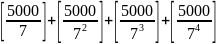
= 714+102+14+2 = 832
Q9. A heap of pebbles when made up into group of 32, 40, 72, leave the remainder 10, 18 and 50 respectively. Find least number of pebble in the heaps.
(a) 1219
(b) 1574
(c) 1418
(d) 1773
Ans. c
Sol. In this type of problem we find the difference of divisors and their remainders.
Here difference,
32 – 10 = 22
40 – 18 = 22
72 – 50 = 22
Here, in each case difference is same i.e. 22
Then required number of pebbles is given by
[(LCM of 32, 40, 72) -22]
32 = 2 × 2 × 2 × 2 × 2
40 = 2 × 2 × 2 × 5
72 = 2 × 2 × 2 × 3 × 3
Hence,
LCM = 2 × 2 × 2 × 2 × 2 × 3 × 3 × 5 = 1440
Thus,
Required number of pebbles,
= 1440 – 22
= 1418
Q10. In a 4-digit number, the sum of the first two digits is equal to that of last two digits. The sum of the first and last digits is equal to third digit. Finally, the sum of the second and fourth digits is twice the sum of the other two digits. What is the third digit of the number?
(a) 4
(b) 8
(c) 1
(d) 5
Ans. d
Sol. Let the 1st, 2nd, 3rd, and 4th digit be a, b, c, and d respectively. Then,
a + b = c + d —- (i)
a + d = c ———(ii)
b + d = 2(a +c) — (iii)
from equation (i) and (ii), we get
a + b = a+ 2d
⇒ b = 2d
Substituting the value of ‘b’ and ‘c’ in equation (iii). We get
2d + d = 2(a + a + d)
⇒ 3d = 2(2a + d)
⇒ d = 4a
or a = 
Now, from equation (ii),
a + d = c
 + d = c
⇒ c = 
The value of ‘d’ can be either 4 or 8.
If , d = 4, then c = 5
If, d = 8, then c = 10
But the value of c should be less than 10, so
c = 5
Q11. All the page numbers from a book are added, beginning at page 1. However, one page number was added twice by mistake. The sum obtained was 1000. Which page number was added twice?
(a) 44
(b) 10
(c) 31
(d) 28
Ans. b
Sol. Let the total pages be ‘n’ and the number which is added twice is x;
∴  = 1000 – x
⇒ n(n + 1) = 2000 – 2x
By hit and trial method, we can assume that if the number of pages is 44, the sum will be

So, the number 10 was added twice, since the given sum is 1000.
(or)
 = 1000
n(n+1) = 2000
most appropriate value of n= 44.
Now, 
Therefore, the page number that was counted twice is : 1000 – 990 =10.
Alternate method
We need to find integer ‘n’ such that
1000 = ( Sum of natural numbers from 1 to n) + r
where r € (belongs to) the set {1,2,3,…….,n}
This requirement is met by the integer n=44
Sum of first 44 natural numbers =

⇒ r = 10
Thus the book has 44 pages and page number 10 was added twice.
Q12. Let S be the set of prime numbers greater than or equal to 2 and less than 100. Multiply all the elements of S. With how many consecutive zeros will the product end?
(a) 13
(b) 7
(c) 1
(d) 19
Ans. c
Sol. For number of zeros we must count number of 2 and 5 in prime numbers below 100. We have just 1 such pair of 2 and 5.
Hence we have only 1 zero
Q13. After the division of a number by 3, 4 , and 7, the remainders obtained are 2, 1 and 4 respectively. What will be the remainder if 84 divides the same number?
(a) 37
(b) 61
(c) 48
(d) 53
Ans. d
Sol. ⇒ In the successive division, the quotient of first division becomes the dividend of the second division and so on.
⇒ Let the last quotient be p, so the last dividend will be 7p + 4 which is the quotient of the second division.
⇒ So, the second dividend is (7p + 4) × 4 + 1.
⇒ Applying the same logic, the number = 3 {4(7p + 4) + 1} + 2 = 84p + 53
⇒ Hence, if the number is divided by 84, the remainder is 53.
Alternate method
3, 4 , and 7, the remainders obtained are 2, 1 and 4
3, 5 and 8 leaves remainders 1, 4 and 7
Let the quotient be q when divided by 7.
n=3(4(7q+4)+1)+2
n =3(28q+17)+2
n = 84q + 53
So, if the number is divided by 84, then the remainder is 53
Q14. Convert the number 1982 from base 10 to base 12. The result is
(a) 1192
(b) 1074
(c) 1296
(d) 1237
Ans. a
Sol. Quotient of  , remainder = 2
Quotient of  , remainder = 9
Quotient of  , remainder = 1
remainder of 
Q15. The last digit of the number obtained by multiplying the number 81 × 82 × 83 × 84 × 86 × 87 × 88 × 89 will be
(a) 11
(b) 3
(c) 6
(d) 9
Ans. c
Sol. The last digit of multiplication depends on the unit digit of (81 × 82 × 83 × 84 × 86 × 87 × 88 × 89) which is given by the remainder obtained on dividing it by 10

We take individual remainders of each digit,
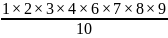
Multiplying numbers, we get
⇒ 
Further taking individual remainders, we get
⇒ 
⇒ 
⇒ 6
Therefore, remainder = 6. So last digit will be 6
Q16. A forester wants to plant 44 apple trees, 66 banana trees and 110 mango trees in equal rows (in terms of number of trees). Also, he wants to make distinct rows of tree (i.e. only one type of tree in one row). The number of rows (minimum) that required is:
(a) 13
(b) 10
(c) 15
(d) 18
Ans. b
Sol. In such case,
We first need to find the HCF of 44, 66, 110
44 = 2 × 2 × 11
66 = 2 × 3 × 11
110 = 2 × 5 × 11
HCF = 2 × 11 = 22
The number of trees in each row will be 22.
Then, the required number of rows.
= 
= 10
(or)
After finding HCF
From given data total number of trees is 44 + 66 + 110 = 220
Dividing the total trees count with trees count in each row
Total minimum rows =  =10
=10
Q17. Find the greatest number which will divide: 4003, 4126, and 4249, leaving the same remainder in each case.
(a) 32
(b) 47
(c) 37
(d) 41
Ans. d
Sol. Rule- Greatest number with which if we divide P, Q, R and it leaves same remainder in each case.
Number is of form = HCF of (P – Q), (P – R)
Therefore, HCF of (4126 – 4003), (4249 – 4003)
= HCF of 123, 246 = 41.
[Taken for Positive result].
Note:
The numbers can be written as,
4003 = AX + P where P = Remainder
4126 = BX + P
4249 = CX + P
(B – A) × X = 123
(C – B) × X = 246
Thus the X is factor of 123 and 246
Q18.
If  is added to the square of a number, the answer so obtained is 10768. What is the number?
(a) 48
(b) 53
(c) 41
(d) 59
Ans. a
Sol. Let the number be x
x2 + 922 = 10768
x2 = 10768 – 922
x2 = 10768 – 8464
x2 = 2304
x =48
Q19. Which of the following is divisible by 3?
(a) 139075
(b) 741082
(c) 231897
(d) 313243
Ans. c
Sol. A number is divisible by 3, if the sum of the digits of the number is divisible by 3.
Sum of the digits of 231897 = 30, as 30 divisible by 3. This is our answer
Check other numbers,
139075 = 25
741082 = 22
313243 = 16
Q20. The square of a number greater than 1000 that is not divisible by three, when divided by three, leaves a remainder of
(a) 1 always
(b) 2 always
(c) Either 1 or 2
(d) Cannot be determined
Ans. a
Sol. In such cases remainder will always be 1.
